ROUNDUP Magazine Profile of Writer-Photographer LaVerne Harrell Clark by critic Lou H. Rodenberger
by Lou Halsell Rodenberger
LaVerne Harrell Clark, like many writers growing up in Texas and the Southwest, was blessed by membership in a storytelling family. As an only child, LaVerne sat quietly a good many hours listening to family raconteurs, but her hands were never still. She sketched whatever came to mind as her elders talked. In school she found an outlet for her creativity in music and enjoyed her ro1e as a clarinetist in the school band. She discovered as well that she liked to write. Such versatility in her creative interests made for a big dilemma when the sixteen-year-old Smithville, Texas native arrived on the campus of Texas Woman's University (then Texas State College for Women).
LaVerne was faced with choosing between her love for music and her talent for writing. TWU had good journalism and English departments, so those courses seemed the best choices. It wasn't long, however, before she was absorbed in yet another outlet for her creative energy. Her photography classes introduced her to a field she had never considered as important to her future, but the satisfaction she found in recording experience pictorially would lead to an avocation that LaVerne would find useful and challenging as she pursued her writing career. She has illustrated most of her work with her own photographs, and admits that all of her life she has been torn between photographing life as she observes it and examining experience by writing about it. LaVerne once observed that she has a dual personality, one that has "always been a divided spirit of the visual arts and the language."
LaVerne's self~assessment of her talents obviously is on the mark. In 1998, her first book-length fiction, KEEPERS OF THE EARTH, won the Western Writers of America Medicine Pipe Bearer's Award for Best First Novel. Her photos are illuminating additions to the novel. This first novel is for the author a culmination of a long history of successful publishing in several genres. Her first major work was the award-winning THEY SANG FOR HORSES: The Impact of the Horse on the Folklore of the Navajo and Apache (1966), a cultural history which originated in her thesis for her Master of Arts degree at the University of Arizona in Tucson, where she and husband L.D., also a novelist and professor at UA, settled after he finished his MA at Columbia University in New York City. After receiving her MA, LaVerne was instrumental in the founding of the University of Arizona Poetry Center and served as its first director from 1962-1966. Even after she resigned her position to turn to her writing career full-time, she still continued to do photography for the Center until 1999 when she and L.D. left Tucson to make their home in their native Texas.
After turning to her writing career full-time, she soon took up short-story writing again, which she had started at Columbia University the fall after her graduation from TWU. Hermes House Press in New York City published her collection, THE DEADLY SWARM & OTHER STORIES in 1985. By 1992, she had also earned an MFA in Creative Writing from Arizona. Once again, her thesis inspired publication. When the publishers at Cinco Puntos Press in El Paso read the work. then titled "The Restoration," they encouraged revision for their release as a novel. This Press had just initiated the Hell Yes! Texas Women Series, and with LaVerne's photos introducing each chapter, KEEPERS OF THE EARTH was published in 1997. Inspiration for the title comes from the epigraph La Verne chose for her novel: "And the Lord God took the man, and put him into the Garden of Eden to dress it and to keep it."
Interestingly, three chapters of KEEPERS OF THE EARTH appeared first in somewhat different versions as short stories in literary journals under the titles, "The Crape Myrtle," "Silvester's
Scheme," and "The Restoration." As a self-admitted perfectionist LaVerne is a deliberate maker of short fiction. Her knowledge and love of Southwestern folklore, her legacy from storytelling family members, and her attention to the visual in detail all are evident in her stories.
LaVerne's humor is subtle, but it leavens her plots, which explore the tragedies in human struggle with life's uncertainties. In one of her strongest
stories, "Once Again on All Souls," which was a Westen Writers' Spur Award finalist in 1985, LaVerne reflects her training as a folklorist as well. After witnessing a Papago Indian celebration of All Soul's Day, a ceremony important to Mexican folk culture as well, she shaped a story, both funny and tragic, about a relationship that ignores both age and racial difference. Major events in the story occur at grave side on All Souls' Day.
LaVerne and L.D. live now in SmithvilIe, where KEEPERS OF THE EARTH is set, and where LaVerne says she feels most at home. She concludes discussion of her love of this region with the observation that "the preservation of my homeland's natural appeal figures among my foremost fictional concerns." Graphic description of landscape and people in her fiction prove her point.
. . . . .
Lou Rodenberger, also a Texas native, has published several books and essays on Texas and Southwestern writers. She is co-editor, with Sylvia A. Grider, of LET'S HEAR IT: 22 STORIES by TEXAS WOMEN WRITERS, published by Texas A&M University Press (Fall, 2003.)
-----------------------------------------
Other profiles of LaVerne Harrell Clark by Lou Rodenberger and her co-editor Sylvia A. Grider appear in their study entitled, TEXAS WOMEN WRITERS: A TRADITION OF THEIR OWN (Tx. A&M University Press, 1997), p.183, and also in their anthology, LET'S HEAR IT (Tx. A&M University Press (2003).
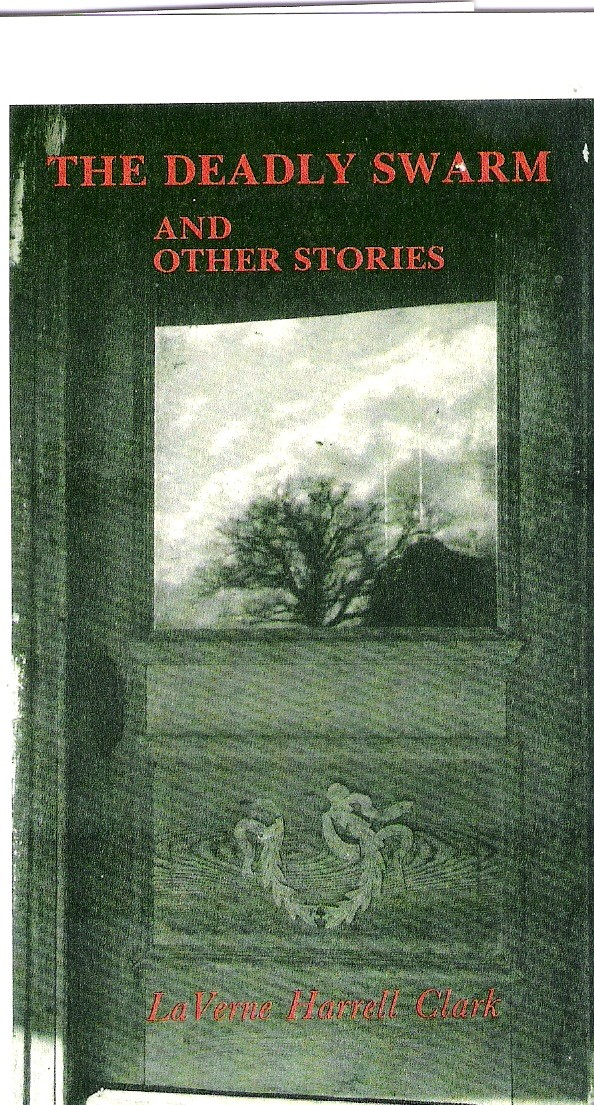
Clark\'s book of short stories, THE DEADLY SWARM, has a cover and is illustrated throughout with her photos of scenes and landscapes of rural life in and around her native Smithville, a small town on the Colorado River near Austin, where she again lives today. The stories have themes like those suggested by this doorway. It served as the front door to the old home of her grandparents. See a later attached account for more information about and some quotes from the reviews of THE DEADLY SWARM.

As the article notes, LaVerne, as a little girl, liked to sketch while she listened to family raconteurs. From her earliest years, she especially loved the stories she got her dad, Boyce Harrell, to tell her. He stands beside her in this snapshot her mother made before the chinaberry tree (the kind of tree familiar to Clark\'s fiction) that stood in their yard. He, a sixth generation Texan who taught her to love history and poetry, often laughed about how, even as a tyke, she paid such close attention to the stories he usually made up to please her that she would swiftly correct him if he omitted or even changed a detail when she would succeed in getting him to repeat one. He had a beautiful handwriting and a writing ability besides. To her great sorrow, he died just a few weeks before her 1st. book\'s release, never getting to see it. But she did manage at least to tell him that it was dedicated to both him and her mother.

The photo of a fall \'04 signing for the LET\'S HEAR IT anthology featuring 22 Texas women short story writers shows, in the center(r.),Lou & Charles Rodenberger with her co-editor Sylvia Grider (to his r.) They are flanked at either end by 2 of their contributors, pictured with their husbands beside them: Betty Wiesepape (r.) and LaVerne Clark (l.)For more on Clark\'s story in LET\'S HEAR IT, see the separate article on Clark\'s short stories in THE DEADLY SWARM.

This picture of LaVerne Harrell Clark, photographed by L.D. Clark, accompanied this magazine article. It shows Clark at a luncheon, holding a present containing a bud vase which Pres. Carol Surles of TWU gave her at the event honoring the publication of her novel, KEEPERS OF THE EARTH (1997). The picture was made just before Clark\'s reading from it at the Library, which in 1973, began collecting her papers. Their holdings now also include some of L.D.\'s writings--a logical place for them since he grew up in the nearby town of Gainesville,TX, and sets much of his fiction there.